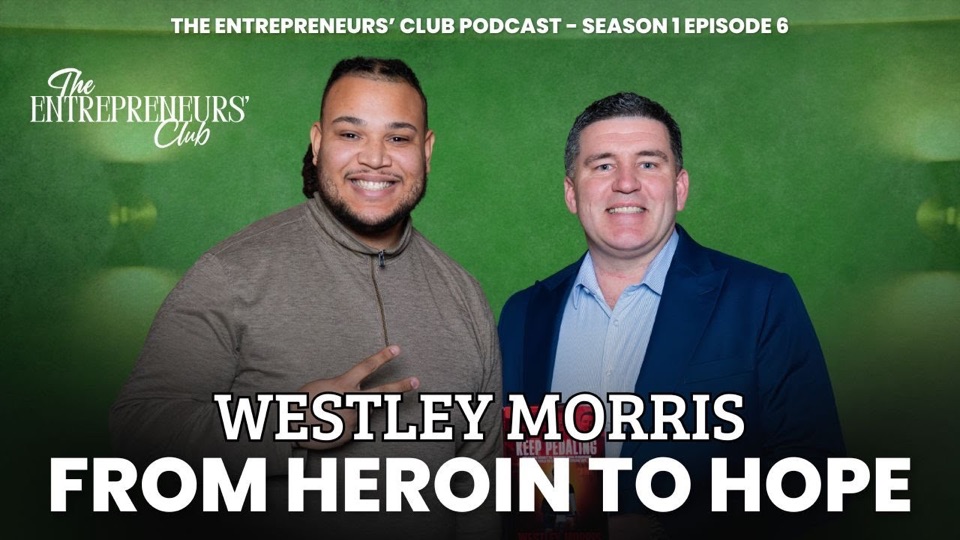
Westley Morris describes himself as an inspirational and motivational speaker from Bethlehem, Pennsylvania, and an entrepreneur since diapers. He comes from five generations of working-class farmers in central Pennsylvania, where he says he got his work ethic and values.
He joined Carter McKinney at the Foundry Recording Studio in Bethlehem for an honest conversation about recovery, rebuilding, and the lessons he took from a bicycle he never expected to need.
The day everything changed
Morris’s mother brought the family to the Lehigh Valley when he was nine months old and opened her own business in Hellertown. He played football, baseball, and wrestled, and thought he had a normal life. Then, in 1997, he came home from school to find state police detectives surrounding the house and watched his mother led out in handcuffs, arrested over what had been happening at her massage parlor.
No one sat him down to help him process it. Left alone with it, he decided he was the bad kid and that his mother did not love him, and he lived up to that belief. By 19, he had lost his driver’s license for 22 years as a result of DUIs and underage drinking charges. At the time, he says, it was simply his life; only later did he have the contrast to see how hard it was.
At 25 he moved to Philadelphia, convinced the Lehigh Valley was the problem. He was hurt at work, prescribed pain medication, and became addicted. He ended up homeless and using heroin in Kensington, about 50 pounds lighter than he is today. At 28, he surrendered to the fact that he did not know what he was doing, and that opened the door to letting someone else help him.
“I figured if I could change my environment that my results would change. But here’s the thing I didn’t realize: I was taking me with me.”
The bicycle as a blueprint
Without a license, Morris started riding a bicycle, and at first he thought it was the worst thing that ever happened to him. He rode eight and a half miles each day from West Bethlehem to Hellertown to help his mother’s massage business, listening to motivational speakers the whole way. Cycling became a form of meditation, a time to reprogram his thinking from limitation toward his full potential.
Later, on what he describes as a message from God, he rode roughly 500 miles to South Carolina over nine days to speak to 200 kids who did not have fathers. After he came home, he says, the bike became a metaphor for a meaningful life. The handlebars are your decisions, filtered through a defined purpose. The frame is your mental and physical health. The pedals are your dreams, and the chain is your daily actions, where your weakest habits hold you back. The gears are knowing when to shift, the wheel is your support system, and the tires are inspiration and motivation that need refilling daily.
The seat means supporting yourself, because nobody will believe in your dreams like you do. The water bottles ask what you are carrying: resentment, or love, hope, and joy. And the brakes are a reminder to slow down and take in the view.
“Life is so beautiful at 8 miles an hour. So keep pedaling.”
Writing it down
Morris was not a reader growing up and was labeled with ADD and ADHD, but studying successful people taught him that leaders are readers. He wrote his book over about 18 months with a writing coach to keep him accountable, a connection made through the Empowered Living community and his mentor Paul Martinelli. He wanted to leave something lasting for the people who come after him, because too many of us die with our stories still in us. Writing it himself, rather than leaning on AI, gave him lessons he would not have gotten otherwise.
He says the book has sold more than 3,000 copies, and he plans to revise it into a workbook built around the bicycle questions. Speaking, he says, chose him, and he has done the hard work to master it.
“It’s not the goal that’s important. It’s not waking up and being a professional paid speaker. It’s the process of becoming that person. That’s the real payoff.”
A comeback in the family business
Morris calls his mother the coolest person he has ever met. She stayed in the same town and fought while others shut her out. About three years after the arrest, he came home to find Philadelphia Eagles quarterback Donovan McNabb in the house. His mother went on to become head massage therapist for the Eagles, a comeback he calls the most amazing he has ever heard.
Years later, Morris took over the business. He rebranded it, built a new website, brought in technology, and says he grew it 1,000 percent in five and a half years, reaching 15 therapists and working with Olympic, college, PGA, and NFL athletes. Along the way he was named most influential man of the Lehigh Valley by Lehigh Valley Style and received citations from the U.S. Senate and House. Then he gave the business back to his mother, who still runs it.
Fail first, then improve
Looking ahead, Morris is partnering with author Ed Rush on a larger project. His advice for aspiring authors and speakers is to keep going and get the reps, because everyone wants the top of the mountain without the process. He shares a line he heard from an actor: if you don’t quit, you might make it.
He also believes in failing fast. In the same studio where this episode was recorded, he paid to fail first, because you cannot improve a result until you have one. Results, he says, are not good or bad, only desired or undesired, and getting emotionally attached to them only blocks better ones.
“Your future potential has nothing to do with your current results.”
- Changing your environment will not change your results if you bring the same thinking with you.
- Define your purpose so every decision can be filtered through it.
- Your weakest habits, not your strongest, are what keep you from your goals.
- Treat results as desired or undesired, not as a verdict on what is possible for you.
- Get the reps and be willing to fail first, because you cannot improve a result you do not have.