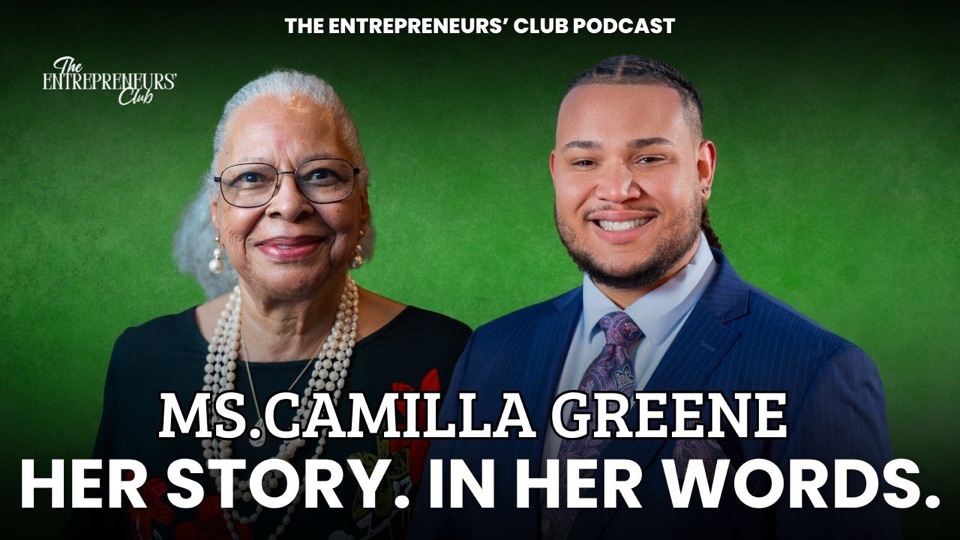
Ms. Camilla Greene wanted her story to be told. Before her passing, she sat down with Carter McKinney on The Entrepreneurs’ Club Podcast to tell part of it in her own words. She was an educator, equity facilitator, consultant and community elder whose work spanned decades, and she said she was honored and humbled to share it.
What follows is that conversation, from a Brooklyn upbringing to classrooms, national school reform and a life in the Lehigh Valley, ending with the question she left for listeners: are you teachable?
Brooklyn and a legacy of Black excellence
Greene was born in Brooklyn, a third-generation New Yorker. She grew up between her grandparents’ brownstone on Bainbridge Street and her parents’ home on the same street.
What set her childhood apart, she said, was being surrounded by Black excellence from the time she could recognize it. She remembered interacting with Shirley Chisholm as a child, counted Adam Clayton Powell among the great figures around her, and played in the street with Cab Callaway’s daughters whenever he visited friends across the street. Her mother was a court stenographer in the Surrogate’s Court and a concert pianist who played organ for Concord Baptist Church and Mount Lebanon Baptist Church. Her father was a New York City police officer in the 1950s and 1960s, when there were few Black officers.
Her faith held two traditions at once. At her Quaker school, the practice was stillness. At the Baptist church, it was a joyful noise. Over time she found herself drawn more to the quiet. She said she respects her 18-year-old grandson’s agnostic view.
Knowing students first
Her reason for teaching traced back to a childhood walk with her grandmother. Wearing white gloves, she noticed a girl who was not, and asked why. When her grandmother said the girl did not know better, young Camilla decided she could help. “That’s why I decided to become a teacher, to take away the mystification of oppression, actually to help people find liberation in education,” she said.
Asked about legacy, she pointed to her classrooms. What mattered was never what she knew, but what she could get her students to want to know.
So she built community. Every class opened with a five or ten minute check-in about what was coming up for each student, because she never assumed young people walked in ready for the curriculum. Those check-ins revealed the weight some of them carried from outside school. Every class closed with a ticket out: each student wrote on an index card what had resonated and what their next question might be.
As a student at Brooklyn Friends School for 13 years, she never needed a pass to go anywhere, because her word was her bond. She brought that trust into public school, where her students went without passes, which upset other teachers.
“I can’t teach you if I don’t know you.”
School reform from the inside
One of her mentors was Ted Sizer, author of Horace’s Compromise, who visited high schools across America and found students bored. He started the Coalition of Essential Schools around the idea that essential questions should drive learning, with teachers serving as a guide on the side rather than a sage on the stage. Greene joined the National School Reform Faculty, a model of teachers helping teachers that released her from her classroom 45 days a year to work with educators in Chicago, Philadelphia and California.
She later worked full time with the Annenberg Institute for School Reform, mostly with Black schools in Chicago, Philadelphia and New York. Many teachers, she said, just wanted to be told what to do. She came to see public education as a sorting mechanism for the marketplace, which leaves little room for questioning the status quo. One lesson from Sizer stayed with her: the best schools have the fewest rules, and those rules make sense to everybody.
Listening across generations
Greene was part of the Hip Hop Genius Network, whose members set out to school her in hip-hop. She asked them to skip the negative, and they introduced her to KRS-One and Jay-Z. She read Jay-Z’s book Decoded, encouraged spoken word with her students, and led workshops with her friend Sam Seidel. It saddened her that many people her age saw no good in hip-hop at all, and she felt that refusal divided the community.
Her career also taught her that people do not always want what they ask for. One organization hired her and another Black woman, then, after hearing their honest feedback, told them within a few months they were not a good fit. “Most people say they want something but they don’t actually know what it’s going to look like when it shows up,” she said.
Finding community in the Lehigh Valley
Greene and her husband lived in Queens and then in Connecticut for 30 years. When their daughter decided to become a single mother by choice, she asked her parents to be her support system, so they sold their home and moved with her to the Lehigh Valley. They later moved to Woodmont Ridge.
She offered an honest view of the region and extended grace with it, noting that when Bethlehem Steel was the major employer, losing a job here was hard to recover from. About 80 families came together to open Seven Generations Charter School in Emmaus, where her grandson attended through second grade, and those same families remained her community. Near the end, she said she was finding peace in authentic community across all races, ages and identities, and that a nonprofit gathering people around equity gave her hope.
Her parting advice to entrepreneurs was to keep asking why your business should exist, to admit what you do not know and ask for help, and to sell the steak, not the sizzle.
“Are you teachable? Are you able to actually confront what you’re doing critically with a critical eye? I believe that all work is inside out.”
- Know the people you serve before you try to teach or sell to them.
- Open with a check-in and close by asking what landed.
- Listen to younger generations instead of dismissing how they speak.
- Ask why your business should exist, and keep asking.
- Admit what you don’t know, and ask someone who does.